New Paper Proposes a Way Through the Polyvagal Theory Controversy
Preprint argues the dispute has stalled because neither side accounts for the body’s neurochemistry, and offers predictions that could settle it in living human subjects
SAN FRANCISCO, Calif., Oct. 26, 2026 — A new preprint from Gabriel Kram of Hearth Science, Inc. and Heather MacDuffie, PhD, of Lifeworks of Maine responds to one of this year’s most widely discussed disputes in trauma therapy and autonomic science. In January 2026, Paul Grossman and 38 co-authors argued in Clinical Neuropsychiatry that Polyvagal Theory is “untenable,” and the theory’s originator, Stephen W. Porges, replied in the same issue.
The paper, “Breaking the Stasis in the Polyvagal Controversy: Two Category Errors, a Missing Variable, and a Measured Boundary,” argues that the twenty-year debate cannot be resolved as currently framed. Neither side accounts for the variable that would decide it: the neurochemistry in which the body’s autonomic circuits operate. The authors argue that the same circuit can produce very different states depending on the chemistry pervading it.
Building on that distinction, the paper:
proposes that shutdown, the collapse response to inescapable threat, depends on the body’s own opioid chemistry. This would distinguish shutdown from freezing, and would mean that the absence of profound heart-rate slowing in freezing is not evidence against shutdown;
offers predictions that can be tested in living human subjects, including that the opioid blocker naloxone, given during shutdown, should reverse its slowed heart rate and breathing;
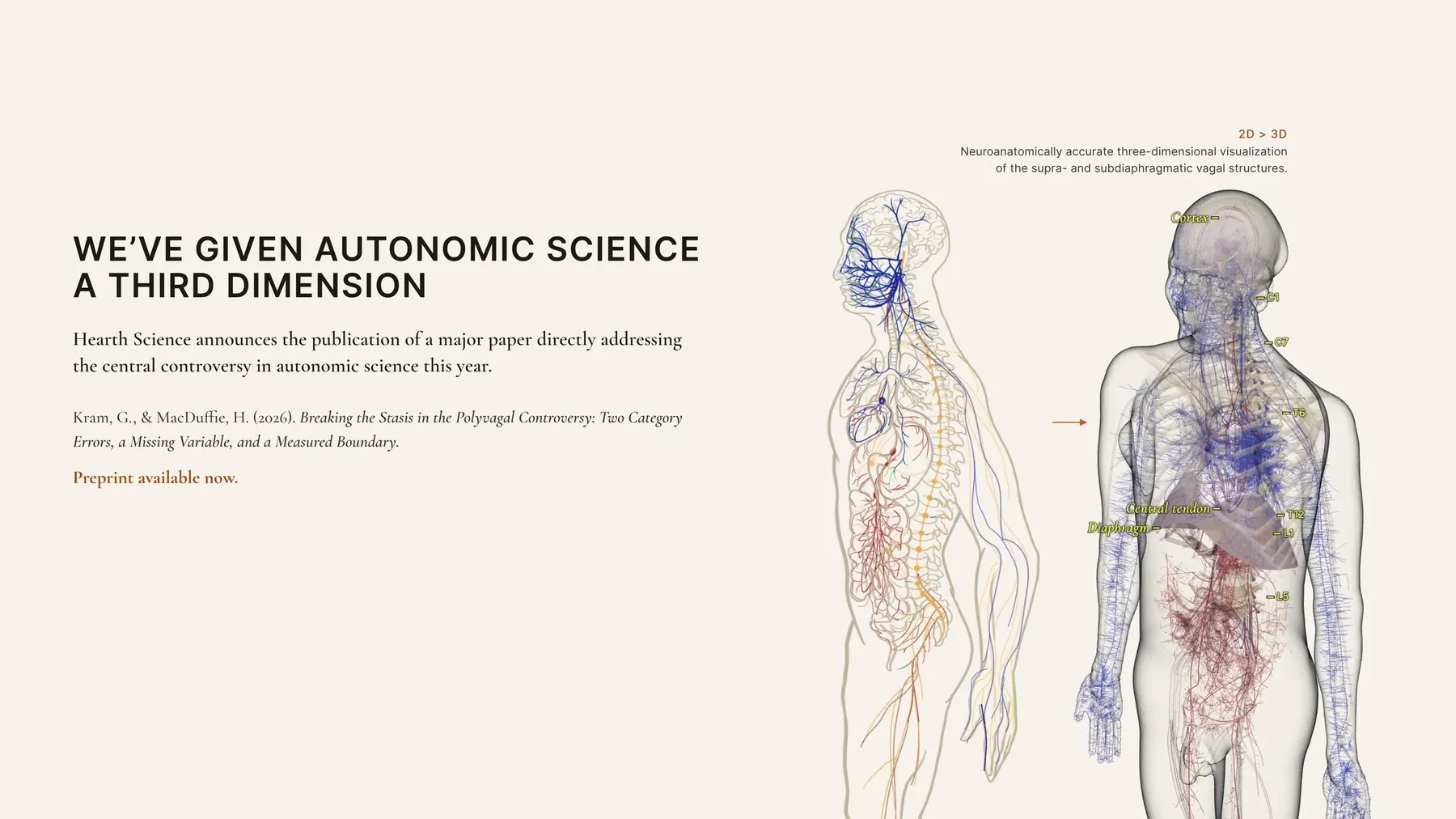
draws on human tissue studies showing that the vagus nerve is about three-quarters sensory, and that its division at the diaphragm, long argued from evolutionary anatomy, can be measured directly;
argues that autonomic science, Polyvagal Theory included, has focused on the nervous system’s motor outputs at the expense of the sensory input where autonomic state begins.
“Clinicians have been pushed to choose between a theory they rely on and a critique they cannot responsibly dismiss,” said Kram. “Both sides describe real observations– this has created an unsettled stasis. What has been missing is the variable that explains why they differ. Once you include it, the controversy becomes something we can test.”
“We have proposed a way to move forward clinically with a rigorous theoretical model that can articulate evidence clinically obtained,” said MacDuffie. “This model prescribes a way forward that builds on reiterative, astute attention to the fullness of body functioning observed in real time, rendering vagal input as one of several factors in the moment-to-moment functioning of human beings, across the spectrum of safety and threat.”
The paper is a preprint and has not yet been peer reviewed. It is available at [BREAKING THE STASIS LINK]. It follows an earlier essay by Kram, The Polyvagal Standoff, published online by Psychotherapy Networker in August [STANDOFF LINK], which sought to separate signal from noise in the controversy and will be a lead article in the magazine’s January 2027 issue on the current status of Polyvagal Theory. The preprint sets out the authors’ proposed resolution.
About Hearth Science
Hearth Science, Inc. is a translation research firm based in San Francisco, California that developed Autonomics, which has remapped the living autonomic nervous system from first principles. The firm generates original research, runs a specialized Autonomics Clinic, trains clinicians, and develops related neuro-technologies.
Media contact: [Gabriel Kram] · [support@hearthscience.io]